Dorjee Tashi, a 51-year-old Tibetan businessman and philanthropist currently serving a life sentence inside Lhasa’s notorious Drapchi Prison (formally known as Tibet Autonomous Region Prison #1), has been assaulted repeatedly by fellow inmates, according to credible information received by the International Campaign for Tibet (ICT). According to sources, instead of protecting him, Chinese prison authorities have used these incidents as a pretext to claim Dorjee’s alleged “misconduct” while in prison and deny him access to his family and legal representation. This follows Chinese authorities’ pattern for years to deny Dorjee access to his lawyer, and Chinese legal experts have described his sentence as fundamentally flawed.
Repeated assaults
Previously undisclosed assaults against Dorjee by prison inmates took place in April 2021 and April 2025, and combined with ongoing refusal of medical care, they pose a serious threat to Dorjee Tashi’s health. At the same time, the assaults and the lack of appropriate responses expose an intentional effort by authorities to punish and abuse Dorjee while he is serving his prison term.
A state’s custody over an individual comes with the fundamental duty to protect a prisoner’s physical integrity and ensure their safety. The failure to prevent or investigate violence against Dorjee Tashi constitutes a violation of the Convention Against Torture, ratified by China, and, more specifically, of the UN Standard Minimum Rules for the Treatment of Prisoners (“Mandela Rules”). The assaults against Dorjee within Drapchi Prison are clear evidence of this failure, demonstrating an environment where he is not safe from harm and where accountability is non-existent.
ICT President Tencho Gyatso said: “Dorjee Tashi’s ordeal is indicative of how Tibetan prisoners are abused, tortured and ill-treated. UN experts and civil society have abundantly documented the systematic nature of torture and ill-treatment in Chinese prisons. Tibetans are particularly vulnerable to torture and ill-treatment as they are subjected to deeply discriminatory laws and policies. We urge the international community to speak out against torture and against the discriminatory policies that embolden this abuse against Tibetans. Most of all, we demand the immediate release of Dorjee Tashi, access to adequate medical treatment and that those responsible for torture and ill-treatment be held accountable. Family members and legal representation must be given adequate access as well.”
The Assaults
The following two incidents have been confirmed, which is most likely targeted violence occurring under the watch of prison authorities:
- 15 April 2025: An assault perpetrated by three other prisoners, which resulted in visible scars on Dorjee’s forehead.
- 17 April 2021: An earlier, more severe assault involving a group of eight inmates.
The significance of these events is compounded by the lack of transparency surrounding the identity of the attackers, and that their motives remain unclear. This lack of transparency and official response creates a presumption of state negligence, and likely outright complicity, in the violence perpetrated against an individual in its custody.

File photo of Dorjee Tashi before his arrest in 2008.
Denial of fundamental rights versus the pursuit of justice
Regular contact with family and access to independent legal counsel are fundamental rights essential to a prisoner’s well-being and their ability to pursue a fair judicial process. For Dorjee Tashi, these rights have been systematically denied by prison authorities to isolate him from the outside world and impede his legal defense.
The right to legal counsel is a cornerstone of any legitimate justice system. Yet, for years, authorities denied Dorjee Tashi’s lawyer, Wang Fei, any opportunity to meet with him. This prolonged obstruction critically undermined the legal appeal process.
When Dorjee’s access to counsel was finally granted in late October 2025, it was severely limited. The consultation was restricted to a one-hour meeting conducted via a prison telephone. It was only during this call that Wang Fei learned of his client’s physical injuries from the assault seven months prior. This discovery underscores how restricting legal counsel not only hampers legal defense but also conceals abuse and prevents independent monitoring of a prisoner’s welfare.
Rather than investigate the assaults or punish those responsible, Chinese prison authorities have turned the attacks against Dorjee Tashi himself. The prison authorities have exploited these assaults as an excuse to block all family and lawyer visits, citing unsubstantiated violations such as “breaking prison rules,” “misconduct,” or “bad behavior.” This tactic—punishing the victim while shielding the perpetrators—has become a standard tactic in China’s prisons: it is a manufactured justification for total isolation, cutting prisoners off from support networks, legal defense, and any hope of outside scrutiny.
Despite the immense obstacles, financial strain, and relentless state harassment, the fight for Dorjee Tashi’s rights and freedom continues with remarkable resilience. His family, especially through his sister Gonpo Kyi’s activism, and his legal representatives are unwavering in their demand for justice.
From separatism to loan fraud: The shifting charges against Dorjee Tashi
The legal case against Dorjee Tashi began with his arrest amidst the 2008 Tibetan Uprising, an event labelled as the “3.14 Incident” (referring to demonstrations on March 14) by the Chinese authorities. The 2008 Tibetan Uprising triggered a brutal crackdown by Chinese authorities, and the shifting charges against Dorjee, from politically-motivated accusations of sedition to a final, spurious conviction for loan fraud, reveal a prosecution driven by political ends with the legal proceedings manipulated to secure a predetermined legal outcome.
The sequence of accusations reveals this troubling pattern:
- Dorjee Tashi was first arrested in 2008 for allegedly “funding activities that endanger national security.” Authorities accused him of maintaining contact with Tibetans in exile. Even under torture during pretrial detention in 2008, Dorjee steadfastly maintained in his testimony, published by the International Campaign for Tibet in August 2021, that he does not have political involvement with any groups.
- The accusations were later altered to include “bribery” and “tax evasion,” yet these charges also did not form the basis of his final conviction.
- In 2010, Dorjee was ultimately sentenced to life in prison for “loan fraud” under Article 193 of the Chinese Criminal Law.
The final conviction was based on a loan of 1.44 million yuan and contained politically motivated and blatant falsehoods regarding the illegality of the loan transaction. Compounding the severity of the sentence, the court ordered the confiscation of all his personal property. Chinese legal experts, in an opinion shared in October 2018, have noted that the sentence is exceptionally harsh and legally disproportionate.
In a recent legal opinion shared on October 24, 2025, by the Beijing based Ningxia Ningzheng Law Firm, lawyer Xiang Longfeng points out that according to Chinese judicial practice, a loan of this size falls into the “huge amount” category, which typically warrants a sentence of five to ten years. A life sentence is normally reserved for cases involving a “particularly huge amount,” a standard generally defined as over two million yuan.
The lawyer’s findings in the Legal Opinion assert that Dorjee Tashi’s case does not constitute loan fraud and should be acquitted, citing errors in jurisdiction, factual findings, and legal application, while emphasizing that the core dispute is a civil financial matter and not a criminal matter.
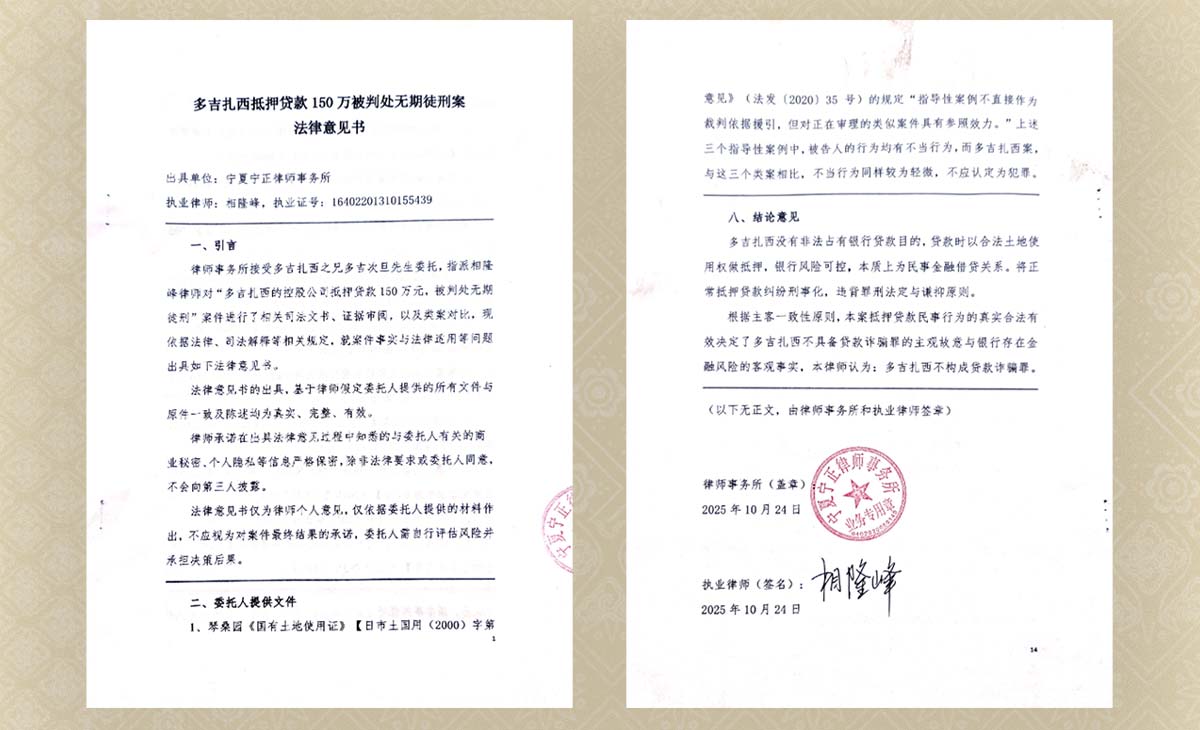
First and last pages of the legal opinion dated 24 October 2025, issued by Beijing-based Ningxia Ningzheng Law Firm.
Key findings from the 14-page legal opinion
- Jurisdictional and Procedural Errors: The Lhasa Municipal Public Security Bureau, Procuratorate, and Intermediate People’s Court lacked jurisdiction over the case because the bank loan occurred in Shigatse (Xigaze), and Dorjee Tashi’s residence was in Shigatse. The case should have been handled by the Shigatse Public Security Bureau. Due to this error, the jurisdictional authority was illegal and hence the evidence obtained should be excluded and the indictment, first instance judgment, and second instance ruling should all be overturned.
- Factual Errors Regarding Loan Recovery and Collateral: The criminal first and second instance judgments made fundamental factual errors by determining that Dorjee Tashi “caused the loan to be irrecoverable” and that the bank was “unable to recover the loan.” This is contradicted by the fact that Shigatse Qinsangyuan Ecological Farming Comprehensive Development Co., Ltd. fully repaid the entire loan by 25 February 2013, after the criminal second instance ruling. Furthermore, the criminal ruling confused administrative errors in land registration with the validity of land rights. The civil judgment regarding the loan dispute found the “Loan Contract” to be authentic, legal, and relevant. Since Qinsangyuan Co., Ltd. provided land use rights that were still valid as collateral, the bank had the means to recover the debt through legal methods, negating the claim that the loan was irrecoverable.
- Failure to Meet the Elements of Loan Fraud: Loan fraud requires objective deceptive means, subjective intent of illegal possession, and causing substantial damage to financial funds. The defense argues none of these were present:
- No Deceptive Means: The land certificate used as collateral was issued by the Shigatse Municipal Land Bureau and was lawful. The bank based its lending decision on this valid property. Importantly, the Agricultural Bank of China Shigatse Branch did not file a criminal report; it pursued a civil lawsuit, indicating the bank viewed the case as a civil dispute.
- No Intent of Illegal Possession: The fact that the entire loan was repaid in February 2013 after the second instance proves Dorjee Tashi lacked the subjective intent of illegal possession of the bank loan.
- No Substantial Harm: Qinsangyuan Co., Ltd. provided land use rights valued at over 16.09 million RMB as sufficient real collateral. Since the bank could fully recover the loan through legal means, the safety of financial institution funds was not substantially harmed. Supreme People’s Court guidance suggests that when adequate collateral is provided and no ultimate loss occurs, the act does not constitute the crime of loan fraud.
- Civil vs. Criminal Nature: The loan activity was between a company with limited liability (Shigatse Qinsangyuan Ecological Farming Comprehensive Development Co., Ltd.) and the bank. If a unit commits a crime, and the gains belong to the unit, it is a unit crime, and units generally cannot constitute loan fraud. The attempt to criminally prosecute Dorjee Tashi for loan fraud in what is essentially a civil financial loan relationship violates the principle of legality and the principle of presumed innocence.
2018 legal experts’ opinion
In October 2018, eight years after Dorjee was sentenced to life imprisonment, a committee of six high-profile Chinese legal experts from Beijing’s Zheng Xin Law Firm in an expert opinion, published by the Rights Defender (维权网) blog, also argued that Dorjee Tashi’s life sentence for “loan fraud” was wrongful. They argued the conduct should have been classified as the lesser offense of “capital misappropriation” (involving 1.5 million yuan), for which life imprisonment is disproportionate, and recommended reducing it to a fixed-term sentence.
The experts further concluded that the punishment was discriminatory, citing the case of Chinese businessmen He Xingyou and Yang Shengli, who were convicted of actual loan fraud involving 53 million yuan received only 15-year sentences on the same charge and by the same judges (presiding judge Yang Tingyi and acting judge Li Ruihong) and around the same time. Those businessmen, having pleaded guilty, have since been released, while Dorjee Tashi—refusing to plead guilty—remained serving a life sentence.
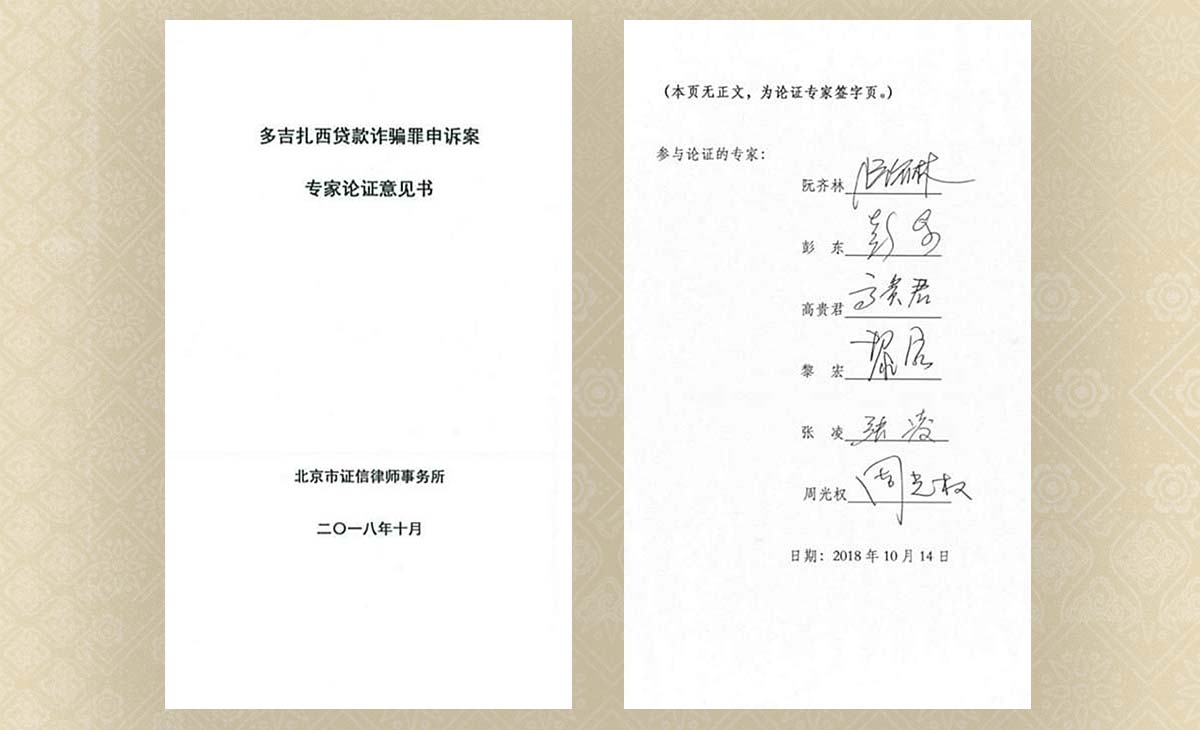 First and last pages of the legal opinion dated 24 October 2018, issued by Beijing-based Zheng Xin Law Firm.
Conclusion
Dorjee Tashi’s ongoing ordeal is not merely a personal injustice; it is compelling evidence of a broader, intentional policy that treats human rights, due process, and the rule of law as obstacles to be surmounted rather than principles to be upheld.
China’s own Prison Law, in addition to binding international law such as the UN Convention against Torture and the International Covenant on Civil and Political Rights, explicitly obligates authorities to protect prisoners’ physical safety, provide timely medical treatment, guarantee lawful family and lawyer visits, and prevent all forms of maltreatment. In Dorjee Tashi’s case, these legal duties have been repeatedly flouted: he has suffered brutal assaults with no investigation, been denied medical care and access to legal counsel. These actions violate both Chinese domestic law and binding international human rights standards with impunity.
ICT demands that Chinese authorities immediately:
- Release Dorjee Tashi from prison unconditionally and overturn his politically-motivated conviction of “loan fraud;”
- Conduct a transparent, independent investigation into the repeated physical assaults on Dorjee Tashi in prison;
- Hold the perpetrators accountable and ensure his urgent medical treatment; and
- In the absence of his immediate and unconditional release from prison, restore his full rights to family visits and legal representation.
ICT further urges Beijing to give due attention to the authoritative legal opinions issued by prominent Chinese legal experts in October 2018 and October 2025, which exposed serious procedural and legal flaws in his conviction. The continued imprisonment of Dorjee Tashi, in open defiance of these expert findings and in the face of mounting evidence of torture and denial of due process, clearly demonstrates that in Tibetan cases, the Chinese judicial system does not function as an instrument of the rule of law, but as a blunt political weapon deployed to achieve predetermined political outcomes.