The People’s Republic of China (PRC) is rapidly modernizing satellite television infrastructure in Tibet that will serve to strengthen China’s monopoly on information in Tibet.
The “livelihood improvement” project aims to transition Tibet to high-definition (HD) broadcasting. 80,000 HD terminals have already been replaced in Chamdo (Changdu) city, and the project will be fully completed in mid-2026, according to Satellite Live Broadcast Center of the State Administration of Radio, Film and Television. Given China’s state policy on access to information, the new infrastructure will likely only allow access to Chinese government-sanctioned and state-controlled TV channels. The International Campaign for Tibet (ICT) therefore concludes that this project is intended to prevent Tibetans from accessing information from outside of China’s state-controlled propaganda apparatus.
Under policy slogans such as “Household Reception,” “Livelihood Improvement,” and “High-Quality Development,” Beijing is systematically replacing older satellite equipment with HD systems. While these installations are promoted as offering crystal-clear picture quality for more than 620,000 live satellite users in the Tibetan Autonomous Region (TAR), their true objective is to seal off Tibet from the outside world – replacing independent voices with a single narrative approved by the Chinese Communist Party (CCP).
Digital equity or control?
Managed by the National Radio and Television Administration (NRTA), the satellite upgrade project is a cornerstone of China’s 14th Five-Year Plan (2021–2025). The stated goal is “high-quality development,” ensuring that even the most isolated nomadic communities have access to modern media. By late 2025, the PRC’s stated goal was to achieve a staggering 99.77% radio and television penetration rate across the TAR.
Officially, the upgrades are framed as narrowing Tibet’s digital divide, providing audiovisual content to satisfy “growing demands” among “ethnic groups.” Benefits cited by state media include expanded access to educational, health, and cultural programming, which is said to foster “shared prosperity” and alleviate poverty by disseminating agricultural knowledge.
However, in reality, this initiative will advance CCP propaganda by ensuring that available content is tightly vetted to promote state-sanctioned narratives of “ethnic harmony” and “Sinicization” within a closed information ecosystem. In a region where independent journalism is virtually non-existent, these satellite broadcasts will function as the primary source of information, reinforcing party-state views on virtually every issue.
A history of silence
This project is not an isolated effort, but rather the culmination of a decades-long campaign to control information access in Tibet. The notorious previous party secretary of the TAR, Chen Quanguo, declared in November 2011 that the objective of China’s media work was to “build a strong wall of steel in the ideological sphere” as part of “the struggle for public opinion on Tibet.” Two months later, he gave further direction telling the Chinese media workers to ensure that “the voice and image of the Dalai clique are not heard and not seen,” and only that of “the Party and central government’s voice and image are heard and seen.” Chen’s directives continue to guide CCP propaganda and information control in the TAR.
Recent rollouts in the TAR
The implementation of satellite television upgrades has been meticulously organized across the TAR’s major prefectures, often accompanied by government ceremonies. Some examples of these rollouts include:
| Prefecture | Key Milestones and Targets | Impact and Scale |
|---|---|---|
| Chamdo (Changdu) | Launched China’s first prefecture-level HD channel in December 2024 to be covered by live satellite broadcast. | The city replaced high-definition terminals for 80,000 live satellite users. Upgrade and replacement work will be fully completed in mid-2026. |
| Shigatse (Rikaze) | Targeted 155,000 rural and herding households for full HD coverage in May 2024 as part of the “New Generation Live Satellite Radio and Television Coverage Project in Agricultural and Pastoral Areas.” | Ensure that 155,000 farmers and herdsmen in the city will achieve full high-definition coverage of live satellite radio and television by the end of the CCP’s 14th Five-Year Plan. |
| Lhoka (Shannan) | Installed new generation Beidou Huhutong live broadcast in Nedong District in late 2025. | The project was framed as “not only a heart-warming practical thing to improve the audio-visual experience of the masses and benefit people’s livelihood, but also a key action to consolidate the ideological position at the grassroots level and cultivate a new trend of civilization.” |
| Nagchu (Naqu) | Live satellite equipment distribution targeting farmers and herdsmen in Zabbel township, Lhari County, Nagchu, for consolidation and strengthening of ideological position in Tibet. | Adds channels 3, 5, 6, and 8 from China Central Radio and Television General Station. TV programs increase from 55 to 95. Radio programs increase from 27 to 46. |
| Nyingtri (Linzhi) | Nyingtri Comprehensive HD Channel live satellite broadcast launched in November 2023. | Covers 11,728 “Huhutong” (Household Communication) live satellite users via set-top box. 27,934 “Village Communication” users require an update in each county/district/city. Approximately 19 hours daily broadcast. |
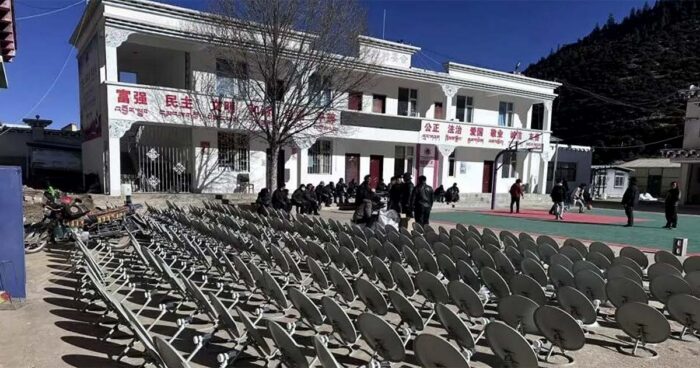
Rows of satellite dishes for distribution in Chamdo. (Image: State media/propaganda, January 2026)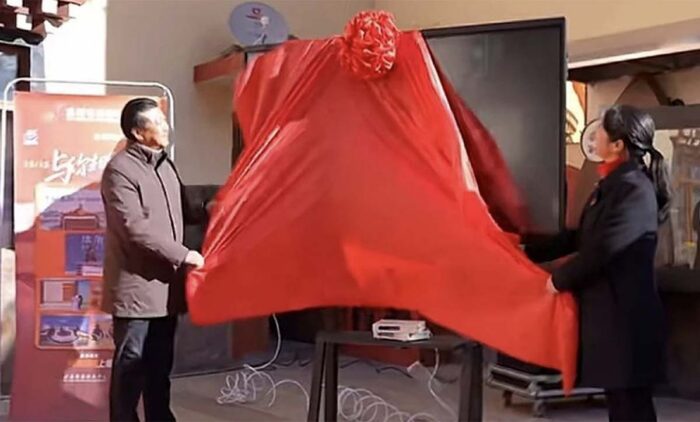
“Chamdo Comprehensive High-Definition Channel” launch ceremony. (Image: State media/propaganda handout, December 2024)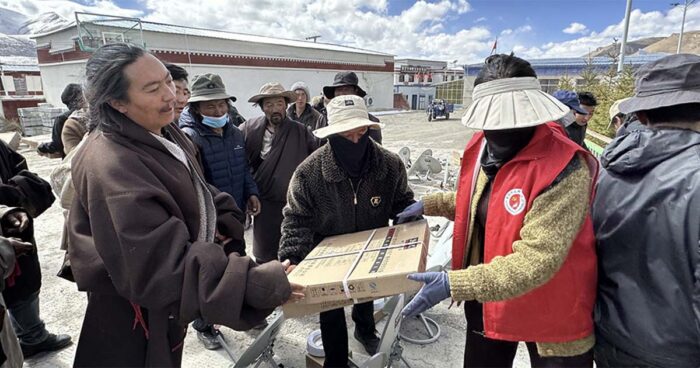
Satellite broadcast equipment being distributed to Tibetan herdsmen in Zabbel township, Nagchu. (Image: State media/propaganda handout, October 2024)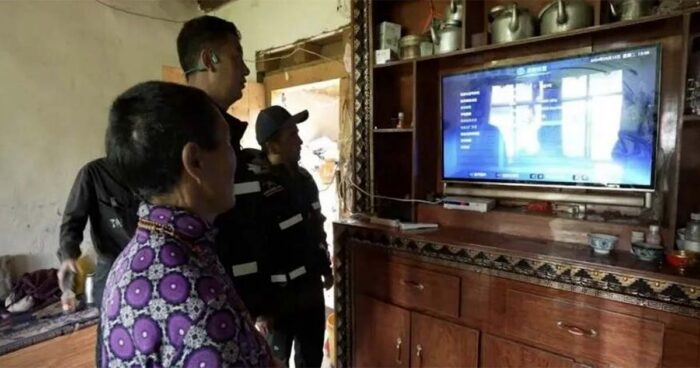
Chinese media workers installing live satellite broadcast equipment in a Tibetan home in Chamdo (Image: State media/propaganda handout, January 2026)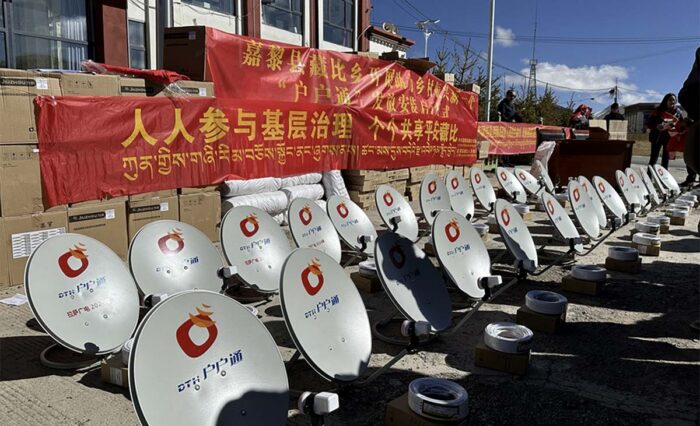
Distribution of Chinese satellite broadcast receiving dishes in Zabbel (Zabbe) township, Nagchu (Image: State media/propaganda handout, October 2024)
Filling the information void
The timing of this modernization push is particularly significant given shifting geopolitical dynamics. As the PRC ramps up its capabilities, the status of U.S.-funded services such as Voice of America (VOA) and Radio Free Asia (RFA) is uncertain. RFA and VOA broadcasts have been silent for nearly a year, allowing China National Radio (CNR) to scale up its broadcasting in Tibet and take advantage of the void. If U.S.-funded services do not resume, Tibetans inside Tibet will be left with no alternative to state-vetted information, exacerbating the already highly restrictive state of independent information access and enabling unchecked party-state propaganda and disinformation.
State-curated reality
The information vacuum in Tibet has consequences that extend far beyond press freedoms and other internationally recognized human rights. The Chinese satellite infrastructure project serves a techno-military purpose, supporting border security and repression under the CCP’s broader strategy of “ethnic harmony.” A key component of that effort is the CCP’s acceleration of the “Sinicization” of Tibetan Buddhism, where religious content is vetted to align with state interests.
As the PRC advances toward its 2026 target of complete HD coverage, access to information for Tibetans in Tibet is likely to be severely curtailed. The “Household Reception” initiative may provide rural Tibetan families with sharper images, but it deepens cultural isolation and further restricts freedom of religion or belief, thought, opinion, and expression. Without meaningful international intervention, including the funding of independent information flow into Tibet through platforms such as the RFA and VOA Tibetan news services, millions of Tibetans risk living within a state-engineered version of reality.