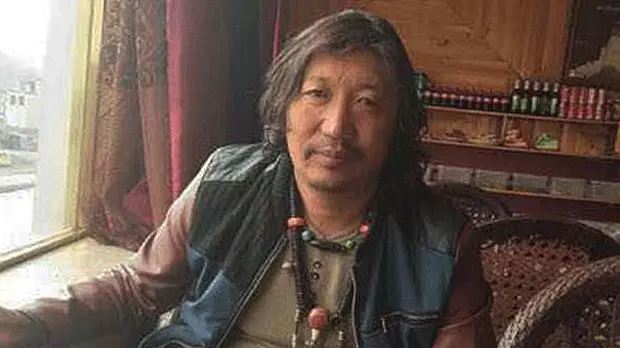
Anya Sengdra, a prominent Tibetan environmental defender and anti-corruption whistleblower, was released from Mianyang Prison on 7 February 2026. Sengdra’s seven-year sentence ended last year but Chinese authorities arbitrarily extended it by a year before suddenly releasing him last week.
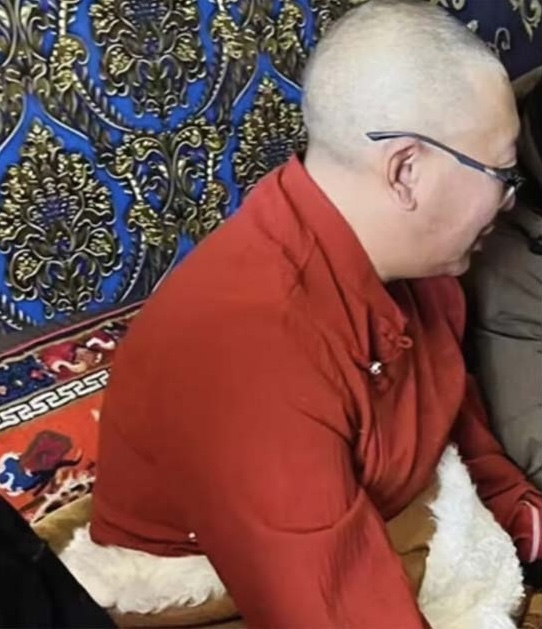
Although Sengdra has returned to his family home in Kyangche (Chinese: Jiangqian) Township, Gande (Gade) County, in Qinghai, eastern Tibet. Initial accounts suggest he suffered severe health complications including vision loss, kidney disease and blood pressure problems while detained. Chinese authorities are reportedly preventing Sengdra and his family from discussing his case or sharing photos or videos of him on social media, and he is reportedly not allowed to travel to seek medical treatment.
Background and activism
Anya Sengdra, a 55-year-old nomad, became a respected community leader through his persistent efforts to safeguard Tibet’s fragile ecosystem and expose local government misconduct. In 2014, he and other nomads founded a voluntary organization known as Mangdon Ling, meaning “Public Affairs Forum.” Through this organization, Sengdra campaigned against illegal mining activities, the poaching of endangered species and the siphoning of public funds by local officials.
His work specifically targeted the mismanagement of poverty alleviation and housing subsidies intended for relocated nomads. In one instance, he questioned the misuse of 18 million yuan meant for housing facilities that do not appear to have ever been built. His activism was effective, and local Tibetans credited his campaigns and arrests for forcing authorities to initiate the payment of the promised subsidies and minimum livelihood allowances.
Arrest and legal proceedings
In 2014, Chinese authorities arrested Sengdra on allegations of illegal activities and sentenced him to one year and three months in prison. He was released from Dongchuan Prison in Xining on October 18, 2016.
Less than two years later, on 4 September 2018, Chinese authorities re-arrested Sengdra on charges of “provoking troubles” and “forming a mob to disturb public order.” These charges are often used under Article 293 of PRC criminal law to silence activists critical of the state. During the first 48 days of his detention, he was beaten and denied access to legal counsel.
On 6 December 2019, the Gande County Court sentenced him to seven years in prison. His lawyer, Lin Qilei, argued that the charges were baseless and part of a broader crackdown on “underworld forces” that the government used to target political and cultural expression in Tibet.
Throughout his imprisonment, reports consistently noted the deterioration of Sengdra’s health. Family members who were finally allowed a brief visit in August 2025 – after years of being denied access – described his frail condition. He reportedly suffered from high blood pressure and did not receive adequate medical care while in detention.
Arbitrary extension of sentence
Sengdra was originally scheduled for release on 3 September 2025. However, Chinese authorities failed to release him on that date, instead extending his sentence until 7 February 2026. Reliable sources indicate the extension was based on alleged “prison rule violations” or theft, though no official announcement or transparent judicial procedure was provided. Organizations such as the International Federation for Human Rights (FIDH) pointed out this extension as a form of arbitrary detention that violated international fair trial standards.
International advocacy
Anya Sengdra’s case garnered significant international attention. In August 2023, three United Nations Special Rapporteurs urged the Chinese government to provide details on his health and detention conditions, emphasizing that the lack of information appeared to be a deliberate attempt to hide his situation from the world.
In October 2025, the FIDH 42nd Congress in Bogota adopted an urgent resolution demanding his immediate and unconditional release. The resolution expressed solidarity with Tibetan environmental defenders who face increasing persecution as the Chinese government scales up mining, dam-building, and urbanization projects across the Tibetan plateau.