The International Campaign for Tibet (ICT) actively engaged in the 61st session of the United Nations Human Rights Council (HRC) from 23 February to 31 March 2026 in Geneva. Through oral statements on behalf of the Helsinki Foundation for Human Rights, meetings with UN Special Procedures, and diplomatic outreach, ICT highlighted ongoing human rights violations in Tibet and raised concerns regarding China’s assimilationist policies targeting Tibetan identity, language and culture.
UN High Commissioner for Human Rights raises concerns about Tibet
During his Global Update to the HRC on 27 February, the UN High Commissioner for Human Rights, Volker Türk, called on Chinese authorities to stop using vague criminal, administrative and national security provisions to suppress the peaceful exercise of fundamental rights. He also urged China to release individuals arbitrarily detained and expressed concern about labor issues as well as restrictions on religious and cultural freedoms affecting Tibetans and others.
In a tweet on 13 March, the Office of the High Commissioner for Human Rights also expressed concern regarding the adoption by China’s National People’s Congress of the “Law on Promoting Ethnic Unity and Progress”. Türk warned that the law risks entrenching assimilationist policies, restricting “minority-language education,” limiting the free practice of religion and cultural freedom and potentially penalizing the peaceful exercise of minority rights.
Interactive Dialogue with the Special Rapporteur on torture
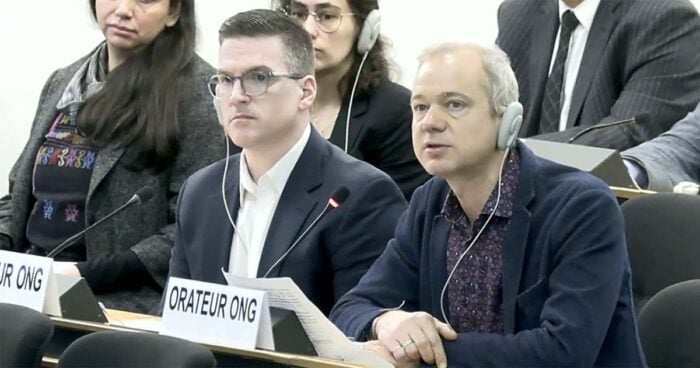
During the 3 March Interactive Dialogue with the Special Rapporteur on torture, Dr. Alice Edwards, ICT’s EU Policy Director Vincent Metten delivered an oral statement on behalf of the Helsinki Foundation for Human Rights highlighting Beijing’s systemic pattern of torture and ill-treatment in Tibet resulting in custodial deaths or deaths shortly after release.
The statement raised several cases illustrating this pattern, including the death of Norsang in detention in 2019 and the case of Gonpo Namgyal, a village leader detained in May 2024 for promoting the Tibetan language and who died shortly after his release from detention.
The statement also drew attention to the case of Zhang Yadi, a young human rights defender advocating for Tibetan rights who has reportedly been held incommunicado since July 2025 and faces a serious risk of torture or ill-treatment.
Metten called on Chinese authorities to end the practice of incommunicado detention and to conduct prompt, independent and impartial investigations into all custodial deaths and allegations of torture.
Interactive Dialogue with the Special Rapporteur in the field of cultural rights
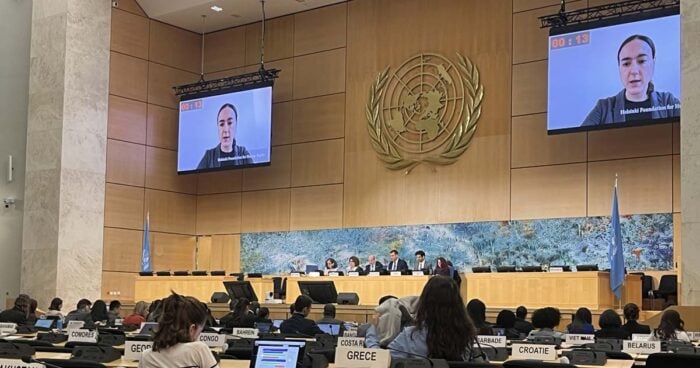
On 4 March, ICT’s Policy and Advocacy Officer Mélanie Blondelle delivered a video statement on behalf of the Helsinki Foundation for Human Rights during the Interactive Dialogue with the Special Rapporteur in the field of cultural rights.
The statement highlighted concerns that Chinese policies are systematically undermining Tibetan culture, language and religion. ICT referenced findings by UN experts indicating that the state-run boarding school system implemented by China in Tibet aims to erode Tibetan language and identity.
The intervention also recalled recent warnings by UN experts regarding allegations of forced labor and large-scale relocation programs affecting Tibetan communities, which may amount to forcible transfer or enslavement as crimes against humanity.
ICT called on the HRC and its members to urge China to end policies that undermine Tibetan cultural rights and to ensure that Tibetans can freely enjoy their cultural identity in accordance with international law.
Item 4 General Debate: Human rights situations that require the Council’s attention
During the General Debate under Item 4, ICT, on behalf of Helsinki Foundation for Human Rights, raised concerns about China’s recent adoption of the adopted “Law on Promoting Ethnic Unity and Progress.” The statement warned that the law consolidates and accelerates the Chinese Communist Party (CCP)’s policy of forced assimilation, particularly in Tibet.
ICT highlighted that the law includes restrictions on the use of Tibetan language in schools and public life and may expand criminal liability for actions deemed to undermine “ethnic unity,” potentially including activities carried out outside China’s territory.
The statement called on the HRC to address how these measures violate China’s international human rights obligations.
Several states raised Tibet during this debate, including Australia, the Czech Republic, Finland, Germany, Iceland, Ireland, Sweden, Switzerland and the UK, as well as the European Union.
Meetings with UN Special Rapporteurs
During the HRC session, Vincent Metten met several UN Special Procedures mandate holders — independent human rights experts who report on thematic or country-specific issues. Discussions focused on the preservation and transmission of Tibetan culture and language, the impact of the boarding school system on Tibetan identity and the implications of China’s new Ethnic Unity Law. ICT also shared information on recent research and individual cases concerning Tibet.
ICT also had the opportunity to engage with the UN Special Rapporteur on torture, Dr. Alice Edwards, following a side event dedicated to the launch of a Charter on the rights of victims and survivors of torture. The exchange addressed ICT’s concerns regarding deaths in custody in Tibet and ICT’s submission documenting such cases.

Engagement with diplomats and civil society
On the margins of the session, ICT also met with diplomats from several states and civil society organizations working on human rights issues related to China and Tibet.
These discussions focused on recent developments in Tibet, the role of the Human Rights Council in addressing serious human rights violations and opportunities for continued advocacy and collaboration.
Side Event on transnational repression
On 3 March , the Society for Threatened Peoples organized an HRC side event focused on the growing threat of transnational repression. The event brought together representatives from affected communities, including Tibetan, Uyghur, and Chinese dissident voices, to highlight how states extend repression beyond their borders. Speakers, including the Representative of His Holiness the Dalai Lama, Ms. Thinlay Chukki, detailed practices such as surveillance, intimidation of family members, cyber harassment and attempts to silence activists abroad. Particular emphasis was placed on the Tibetan case, where exile communities face systematic pressure through both digital and physical means.
Participants also underscored the limitations of existing international mechanisms in holding perpetrators accountable. Organizers further called on states and the UN to strengthen protections for human rights defenders and formally recognize transnational repression as a serious violation of both sovereignty and human rights.
China’s right to reply
On 12 March, the Chinese delegation exercised its formal right of reply and attempted to rebut the wave of criticism from civil society. China accused critics of “fabricating and spreading false information in the name of human rights to attack and smear China’s human rights situation” and said that such “actions should be condemned by the international community.” The Chinese delegation also asserted that Tibet enjoys social and economic stability, ethnic unity and religious harmony. This combative stance underscored China’s continued resistance to international scrutiny, its rejection of UN recommendations and its refuse to adhere to its international human rights commitments. It also demonstrates the importance of raising CCP policies in Tibet in international fora, such as the HRC.